
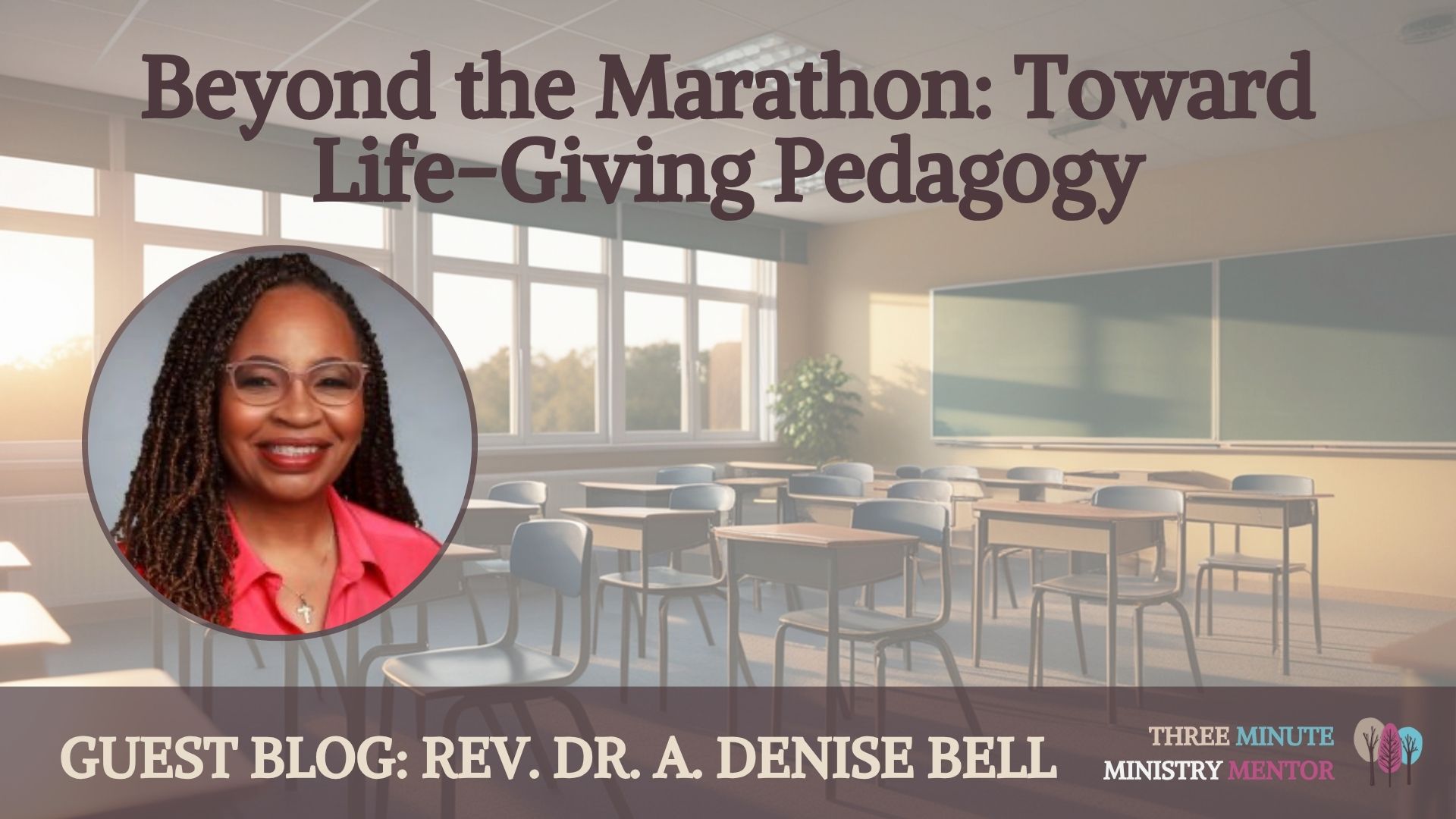
Editor’s Note: Today’s back-to-seminary guest post is by Rev. Dr. A. Denise Bell. She is Donald and Lillian Nunnelly Chair and Assistant Professor of Pastoral Leadership at Lexington Theological Seminary. Dr. Bell served as the Regional Minister of the Christian Church (Disciples of Christ) in Georgia from 2014-2023. For 35 years, she served churches as Disciples pastor in various roles and locations. She also joins us regularly at the Writing Table. Her doctoral research focused on “practices of flourishing African American pastors and challenged research regarding clergy wellbeing.”
Beyond the Marathon:
Toward Life-Giving Pedagogy
When I first began teaching three years ago, I thought of the academic year as a marathon race. The idea was to push through obstacles, navigate twists and turns, negotiate shifting terrain, and calculate the demands on every part of my body. All of this was not to win, but to finish well—both for myself and for my students, colleagues, administrators, and staff.
I must admit, however, I have often found the finish line to be elusive. There is always another book to read, course to revise, article to write, or meeting to attend. After the marathon is over, the urge to pin on a new marathon bib that identifies a new race kicks in like a rehearsed muscle that only remembers “doing.” Ruha Benjamin (2024) suggests that we are shaped by a culture dominated by explicit and subliminal messages prioritizing production and profit over the care of people and the emergence of a strong self. I recognize this mentality in myself as a teacher, and it troubles me.
The Marathon Mentality
The marathon mentality mirrors a culture that refuses to be satisfied by limitations and boundaries needed to cultivate a healthy sense of being. The greatest efforts of theological pedagogy should be to help students resist and overcome the culture that celebrates producing and performing at all costs. Willie Jennings (2020) calls this a “Soul killing performativity aimed at the exhibition of mastery, possession, and control with the tacit assumption that this ongoing work of exhibition illumines talent and the leadership capacity” (p.27).
As I begin this fourth year of teaching, new questions are shaping me. What does it look like for the “doing” to intersect with the “being”? How could I create an exhibition not of mastery, possession, and control, but of illuminating imagination, reflection, and transformation? How can we welcome knowledge generated by a diverse, equitable, and inclusive community that foregoes performativity in favor of flourishing?
Caught Between Soul-Killing and Life-Giving
Jennings also talks about a life-giving pedagogy. This pedagogy points to the spirit of God and a collective work joining fragments of teacher, student, church, institution, and a broken and beautiful world to create something transformative. So, these appear to be the two polarities of pedagogy: soul-killing or life-giving. As an early-career academic, I strive for life-giving but confess that sometimes the soul-killing overtakes me. Last year, I talked with a student who was preparing for a competency exercise. They were to recall what they had learned in a previous course leading up to this summative project and integrate that with another area of the curriculum. In our conversation, it became clear that the student had no recollection of key elements from my course. While it would be tempting to aim my disappointment at the student, Benjamin’s warning about prioritizing production and profit prompted deeper reflection.
Was my course design part of the problem? Was the expectation of speedy memorization and regurgitation of course content decreasing the capacity for absorption and long-term integration? Would this, in turn, set the stage for failure instead of success? Could my pedagogical model be soul-killing instead of life-giving?
At the same time, I question whether there is a deeper problem with the theological education models within which I was trained. Do they, in fact, support dominant structures valuing only short-lived production and performance rather than transformative, life-giving learning?
Choosing Another Mindset
As a new faculty member who transitioned from 35 years of practical ministry, my first three years were driven by three tasks. I needed to learn the teaching craft, turn my experience into content that blends experience, theory, and scholarship, and meet institutional requirements of assessment and accountability. Now, in my fourth year, I am inspired by deeper measures. I believe the learning environment requires input beyond the regurgitation of content, where the student brings their life experience to the classroom. Students can capture self-reflections in portfolios and by partnering in developing accountability tools for wellness practices.
I also believe the learning journey can be enriched for teachers and students through the invitation to be vulnerable and take risks to question syllabi, content, and assignments. Students may be more likely to embody and sustain course content if the learning experience supports intentional collective imagination, reflection, and transformation. Our typical course is one month. Thus, I build intentional examination into course evaluations for the benefit of future students.
A New Academic Year
As I settle into this new academic year, I am un-choosing the marathon mindset. Instead, I want to take my time and embody imagination, self-reflection, and transformation in a pedagogy that sustains learning inside and outside of the classroom. I want to engage students in such a way that this process of discipleship is sustainable and portable in a student’s context beyond the measurement of a course.
As I listen to myself, I recognize that I want a lot of things, but I’m not sure if the broader structures of theological education want those things as well. I hope that this wanting has value and strengthens my virtue as a teacher. Wanting, at its best, sharpens my ability to recognize “soul-killing” pedagogy, the short-lived application of product and performance. And it enables me to practice pedagogy that sustains the imagination, self-reflection, and transformation in myself as a teacher and my students as lifelong learners.
Bibliography
Benjamin, Ruha. Imagination: A manifesto. WW Norton & Company, 2024.
Jennings, Willie James. After whiteness: An education in belonging. Eerdmans, 2020.